
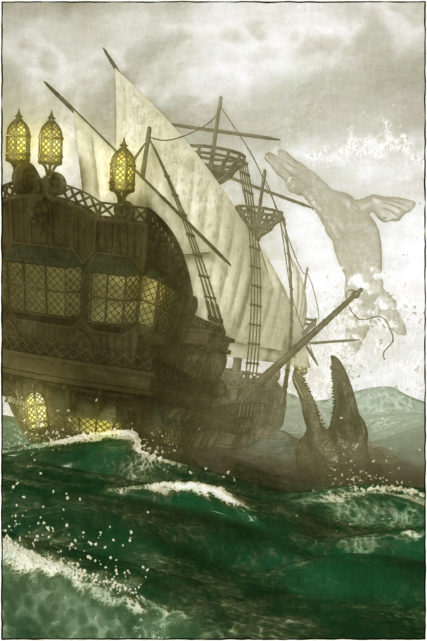
This probably the most time-consuming of all my illustrations, yet it was among the most rewarding. First of all, the ship had to be modeled piece by piece, and though I know ways of speeding that process up, the sheer number of objects in the scene, every board and railing, every sail and line, each window pane and the various ammonites that decorate the decks, contributed to a massively complex scene. Then came the waves and the water, which had to be modeled using dynamic effects, further complicatng the scene. The dinosaurs were perhaps the easiest elements.
These are mososaurus, not the best-known of the aquatic reptiles, but by far the most fascinating. Most people know the fish-shaped ichthyosaurus and, of course, the plesiosaurus of Loch Ness fame, but the mososaurus was an elegant and formiddable creature, a tyrannosaur of the seas. There are three of them in this image, in case you missed one of them.
The sea we are sailing over is called the Great Inland Sea, and once stretched from the Appalachian Mountains to the Rocky Mountains, where our story is actually set. The sea was quite shallow, not nearly as deep as the Mediterranean Sea—which is good, as our characters are about to dive off this ship and swim to the seabed below, which would have been covered with coral reef all the way to Missouri and Iowa, where the remains of various sea creatures can still be found in fossil form today.


