
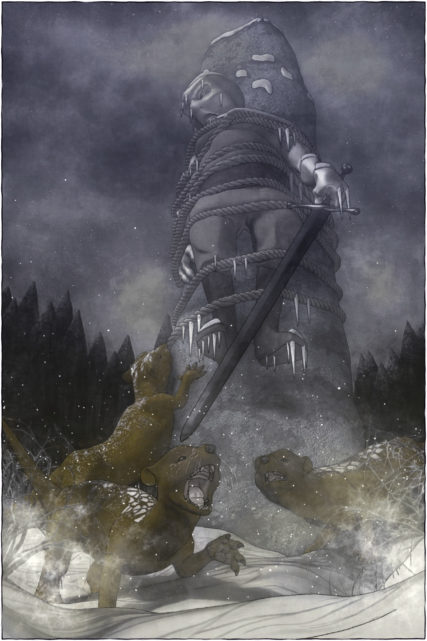
My least favorite character in this entire series was more Varad, Evran’s hapless brother. He might not have joined the story at all, except that he had several roles to fill. Most importantly, I needed someone to pull the sword in the first book and go mad right in front of our eyes. I then got rid of him as quickly as I could, bring him back only as necessary to the plot. I eventually grew to pity the poor man, and I will admit that his abandonment of his little brother in the first book was responsible for developing Evran, as well as Ivanno, into much more fascinating characters. So I ultimately gave him a fitting, honorable end.
This entire tableau is based on the fate of the Irish hero Cú Chulainn, who was determined to fight right up to the moment of death, and so lashed himself to a tall stone and continued fighting. This was perfect for Varad’s final battle, as he knew he would go mad from drawing the sword, but in this way, was still able to protect it. The stone to which he is tied was modeled very closely after the actual Cú Chulainn stone, which I once spent most of a day wandering County Omagh to find and photograph.
The creatures are called didelphodons. I felt the scene needed more menace than just the snow and cold, after all, we are talking about a dead body hanging in the freezing countryside for weeks—something is bound to come sniffing around. But looking over the short list of dinosaurs that I had not already used, none of them fit the icy circumstances. Then I spotted my note regarding the need to show more mammals in the story. I searched out the largest mammal around at the end of the Cretaceous and came across the didelphodon, a strange little creature that perfectly fit the scene. They were slightly larger than a river otter, but more closely resembled a Tasmanian devil, at least in their heads. They were the perfect fit, and even remind me of that sinistar water dog of Irish legend called the Dobhar Chú.


